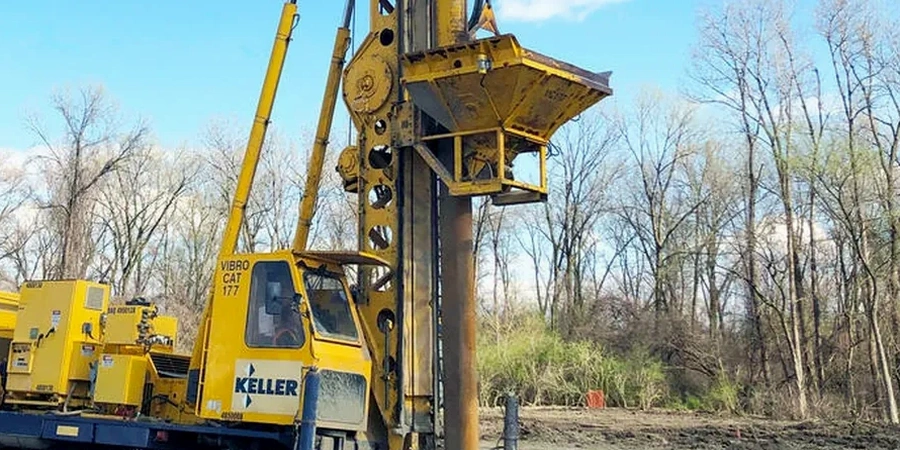
The Los Angeles Basin presents a unique challenge for deep foundations: vast alluvial deposits of loose, saturated sands that amplify seismic shaking. From the LA River corridor to the industrial yards of Vernon, the risk of liquefaction-induced settlement isn't theoretical — it's a daily engineering reality. Vibrocompaction design tackles this head-on by densifying granular soils in situ before a single footing is poured. Our methodology follows ASTM D6066 for evaluating relative density gains, integrated with site-specific seismic parameters from ASCE 7 and the seismic design categories in the current IBC. When layered stratigraphy complicates the picture, we often correlate the design with CPT test data to map fines content and avoid zones where vibro replacement, such as stone columns, would be more appropriate than pure densification.
Seismic densification in LA isn't about reaching a number; it's about eliminating the differential settlement that tears apart post-tensioned slabs during a major event on the Newport-Inglewood fault.
Common questions
How much does a vibrocompaction design package cost for a typical Los Angeles project?
For a standard commercial or industrial site in Los Angeles, vibrocompaction design fees typically range from US$1,510 to US$5,650, depending on the treatment area, depth of liquefiable layers, and number of pre- and post-treatment CPT soundings required. Complex sites with irregular stratigraphy or stricter seismic performance targets fall at the upper end of that range.
What soil types in Los Angeles are suitable for vibrocompaction?
Vibrocompaction works best in clean to slightly silty sands with fines content below 12 to 15 percent. Much of the LA Basin, particularly the recent alluvium along the Los Angeles and San Gabriel Rivers, fits this profile. When silt content exceeds 15 percent, we typically recommend supplemental stone columns or a combined approach to achieve the required density.
Does the City of Los Angeles require a special inspection for vibrocompaction?
Yes. The Los Angeles Department of Building and Safety enforces special inspection requirements per IBC Chapter 17 for deep ground improvement. Our design package includes the statement of special inspections and the verification testing schedule that the deputy inspector follows in the field, ensuring the final compaction report meets plan check expectations.
How do you verify that vibrocompaction achieved the design density?
Post-treatment verification relies primarily on CPT soundings at the centroid of the compaction grid, compared directly to pre-treatment baseline data. We evaluate the increase in tip resistance and sleeve friction, and often supplement with SPT or downhole shear wave velocity testing when the structural engineer requires a direct measurement of small-strain stiffness for dynamic analysis.