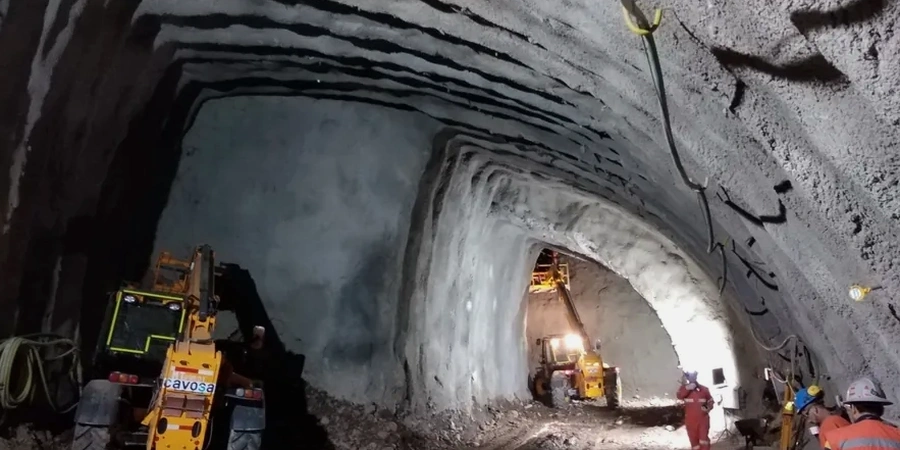
The ground beneath a tunnel boring machine can shift radically between Boyle Heights and Century City. In Boyle Heights the TBM may hit dense Pleistocene alluvium. A few miles west near the La Brea Tar Pits, crews face methane-saturated silts and asphaltic sands. These contrasts define geotechnical analysis for soft soil tunnels in Los Angeles. The LA Basin is a deep sedimentary trough, filled with 30,000 feet of interbedded sands and clays. Tunneling here means managing groundwater, gas pockets, and the constant possibility of crossing a blind thrust fault. The engineering team maps these transitions block by block. Before any alignment is locked, subsurface conditions must be characterized with precision that matches the complexity of the basin. The investigation sequence typically starts with deep borings and transitions to laboratory programs that classify the material. When alignment alternatives cross the Hollywood Fault or the Newport-Inglewood zone, the seismic refraction survey becomes essential to profile rockhead depth and locate weathered shear zones that could destabilize the face during excavation.
Tunneling in LA's soft ground is a race against time — the stand-up time in saturated silt can be measured in minutes, not hours.
Common questions
What makes tunneling in Los Angeles soft ground different from other cities?
The combination of active faults, methane pockets, and deep alluvial basins sets Los Angeles apart. The LA Basin contains up to 30,000 feet of interbedded sediments. Tunnels often cross the Hollywood or Newport-Inglewood fault zones, requiring seismic design that accounts for permanent ground displacement. Gas-charged sands in the Puente Formation add a hazard that few other cities manage routinely.
How do you handle methane risk during a geotechnical investigation for tunnels?
Gas monitoring wells are installed with the exploratory borings. Methane concentration and pressure are measured over time, following LADBS Ordinance 175790. The analysis maps zones of high gas potential and recommends mitigation measures: membrane systems, ventilation design, and real-time monitoring during construction.
What is the typical cost range for a soft ground tunnel investigation in Los Angeles?
A comprehensive investigation program for a tunnel alignment in Los Angeles typically ranges from US$4,200 for a preliminary desktop and limited field study to US$16,370 for a full program including deep borings, triaxial testing, gas monitoring, and finite element parameter development.
How long does a tunnel geotechnical investigation take?
Fieldwork typically runs 3 to 6 weeks depending on alignment length and access constraints in Los Angeles. Laboratory testing adds another 4 to 8 weeks. The full report with ground model and design parameters is delivered in 10 to 14 weeks from mobilization.