← Home · Investigation

Exploratory Test Pits in Los Angeles: Direct Subsurface Assessment

Together, we solve the challenges of tomorrow.

LEARN MORE →

Los Angeles sits atop a complex basin where the San Andreas, Puente Hills, and Hollywood faults shape subsurface conditions in ways that boreholes alone cannot always capture. With over 3.8 million residents and a building stock that ranges from century-old brick to modern steel, the need for direct observation of foundation soils has never been greater. An exploratory test pit provides exactly that: an open excavation that reveals stratification, fill boundaries, groundwater seepage, and buried obstructions in real time. Our team has cut pits from the alluvial fans of the San Gabriel Valley to the hillside benches of Silver Lake, documenting the lenses of silty sand and weathered shale that govern bearing capacity. When a geotechnical report requires confirmation of shallow bedrock depth or the lateral continuity of a colluvial layer, a test pit delivers visual certainty that no disturbed sample can match. We schedule excavation around LA’s notorious traffic windows and coordinate with utility locating services before the bucket breaks ground.

You cannot manage what you cannot see. In LA's heterogeneous soils, a test pit transforms subsurface guesswork into a measured, photographed, and logged reality.

Methodology and scope

The most expensive mistake we see on LA projects is assuming that a few SPT borings spaced 50 feet apart will catch every soft pocket or old debris fill. In neighborhoods like Echo Park or Mount Washington, hillside terracing from the 1920s often buried construction rubble that reads as competent soil on a blow count log. An exploratory test pit opens a continuous face where you can trace a fill horizon laterally and measure its thickness with a tape, not by inference. We log each wall using the Unified Soil Classification System per ASTM D2487, photograph the strata at multiple depths, and collect undisturbed block samples for laboratory grain size analysis when needed. For projects where shallow groundwater complicates excavation, we combine test pit observations with in-situ permeability testing to give the structural engineer a complete picture of drainage and soil behavior. Every pit is backfilled in lifts with compaction verification, leaving the site safe and graded.
Exploratory Test Pits in Los Angeles: Direct Subsurface Assessment
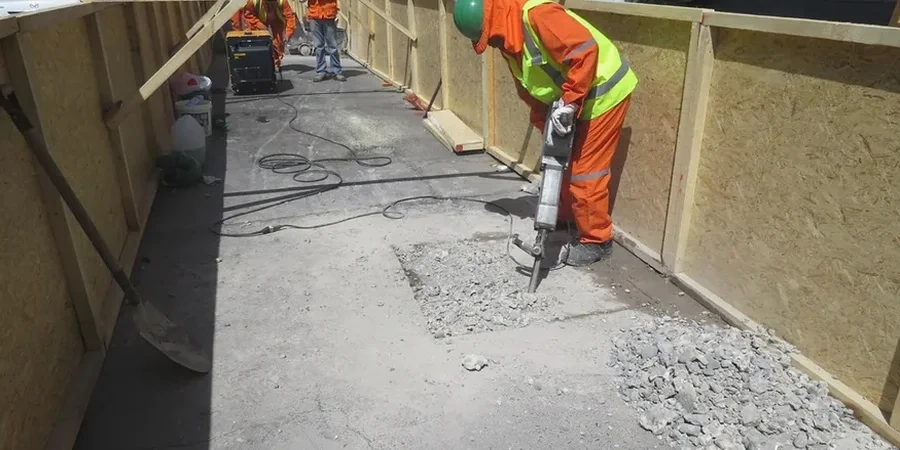
Technical reference image — Los Angeles

Local geotechnical context

The California Building Code (Chapter 18) and ASCE 7-22 require that foundation investigations extend deep enough to capture all strata influencing structural performance. In Los Angeles, this means accounting for the basin effect: deep soft soils overlying stiffer bedrock amplify seismic shaking at periods that match mid-rise buildings. A test pit that bottoms out in a dense Pleistocene alluvium may give a false sense of security if a 40-foot-thick Holocene soft clay lies just beyond the bucket reach. We cross-reference test pit logs with nearby borings and, in liquefaction-prone zones like the LA River corridor, pair visual pit data with SPT drilling to measure blow counts through the critical upper 30 feet. The risk of not performing an exploratory test pit is not just a foundation crack; it is a shear failure at the fill-native interface during a Northridge-magnitude event, a scenario that retrofit costs can dwarf.

Need a geotechnical assessment?

Reply within 24h.

Email: info@geotechnicalengineering1.com

Reference parameters

ParameterTypical value
Typical excavation depth8 to 15 ft below grade
Maximum reachable depth with shoringUp to 20 ft in competent soil
Excavator classMini-excavator (3.5–8 ton) or backhoe
Logging standardASTM D2488 / ASTM D2487 (USCS)
Sampling methodBlock samples, bulk bags, Shelby tubes from pit floor
Shoring requirementCal/OSHA Type C soil classification; trench box if >5 ft
Typical pit dimensions4 ft wide × 8–12 ft long (varies with depth)

Other technical services

01

Hillside and canyon test pits

Excavation on steep lots in areas like Laurel Canyon or Baldwin Hills where colluvium, weathered bedrock, and ancient landslide debris require visual mapping to confirm slope stability assumptions.

02

Urban infill and brownfield assessment

Test pits in former industrial corridors such as the Arts District or Vernon, targeting buried foundations, underground storage tanks, and contaminated fill that complicate redevelopment.

03

Foundation replacement investigation

Pits excavated adjacent to existing footings in pre-1960 construction zones like West Adams, revealing the depth and condition of old spread footings before underpinning or replacement design begins.

Reference standards

IBC 2024 (California Building Code, Title 24, Part 2), ASCE 7-22 Minimum Design Loads and Associated Criteria for Buildings and Other Structures, ASTM D2487 Standard Practice for Classification of Soils for Engineering Purposes (Unified Soil Classification System), ASTM D2488 Recommended Practice for Description of Soils (Visual-Manual Procedure), Cal/OSHA Title 8, Subchapter 4: Construction Safety Orders (trenching and excavation)

Common questions

How much does an exploratory test pit cost in Los Angeles?

In the Los Angeles market, a single exploratory test pit typically ranges from US$440 to US$850, depending on depth, access constraints, traffic control requirements, and whether shoring or a trench box is needed per Cal/OSHA regulations. Deeper pits exceeding 10 feet, those requiring hydro-excavation near utilities, or sites where the spoils must be hauled off due to contamination will fall at the upper end of that range. We provide a fixed-price proposal after reviewing the site plan and underground utility maps.

What can you see in a test pit that a boring cannot show?

A test pit exposes a continuous vertical face, letting our geologist trace the actual contact between native soil and artificial fill, measure the thickness and dip of a sand lens, or identify the orientation of fractures in weathered rock. Boreholes produce disturbed samples and blow counts; a pit reveals the in-situ fabric, root penetration, seepage paths, and the true variability of the ground across a 10-foot horizontal section, which is critical when designing shallow foundations or retaining walls.

Do you need a permit to excavate a test pit in Los Angeles?

In most cases, a test pit for geotechnical investigation does not require a building permit, but it does require compliance with Cal/OSHA excavation safety standards and a Underground Service Alert (USA North 811) ticket at least two working days before digging. If the pit is on public right-of-way, an encroachment permit from the City of Los Angeles Bureau of Engineering is necessary. We handle all notifications and coordinate with utility locators.
Location and service area

We serve projects in Los Angeles and surrounding areas.

View larger map