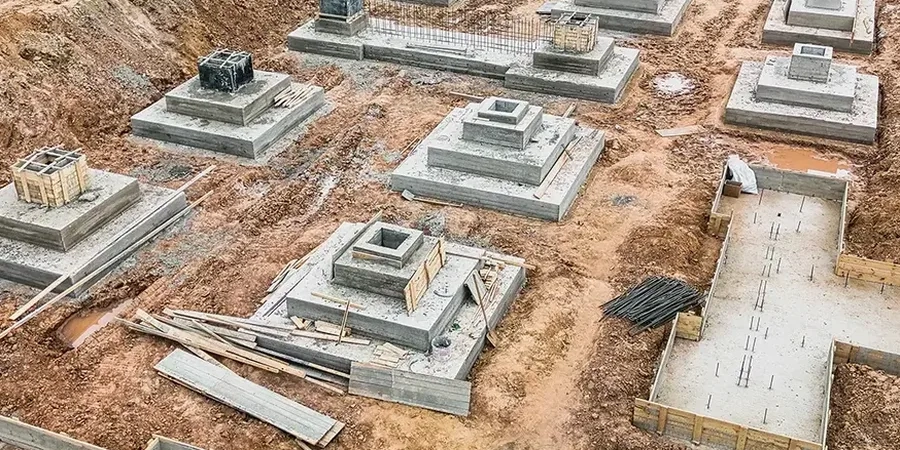
Los Angeles sits in one of the most seismically active regions in the United States, and the IBC with its ASCE 7 load provisions governs every deep foundation we design here. The city's varied geology—from dense alluvium in the basin to weathered shale in the Santa Monica Mountains—means pile foundation design must account for more than just vertical bearing. Lateral spreading, basin-edge effects, and deep soft clay layers in areas like the LA Basin demand careful selection of pile type, length, and reinforcement detailing. We apply site-specific response spectra and, where the Seismic Design Category requires it, run full kinematic interaction analyses. For sites with marginal upper soils, a CPT test provides continuous resistance profiles that feed directly into our pile capacity models, while liquefaction assessment determines whether downdrag and loss of skin friction must be factored into the ultimate limit state.
Properly designed piles in Los Angeles transfer loads past the active seismic zone and into competent bearing strata—skipping this step invites differential settlement after the first moderate event.
Local geotechnical context
Soil conditions shift dramatically between two adjacent areas of Los Angeles: the flatlands of South LA and the hillside lots of Silver Lake. South LA sits on deep Holocene alluvium with groundwater within 20 feet—fine-grained soils that amplify long-period motion and are susceptible to cyclic softening. Silver Lake, by contrast, rests on stiff Pleistocene-age Lakewood formation, often with shallow bedrock, but perched groundwater and steep cut slopes introduce lateral pressure and erosion concerns. A pile foundation optimized for South LA will likely need extended lengths to bypass liquefiable layers and develop sufficient skin friction in deeper competent strata. In Silver Lake, the challenge is more about lateral resistance and resisting slope creep. Treating both sites with the same standard pile section leads either to overdesign in one or underperformance in the other.
Reference standards
IBC 2022 Chapter 18 – Soils and Foundations, ASCE 7-22 Chapter 12 – Seismic Design Requirements, ASTM D1586 – Standard Test Method for SPT and Split-Barrel Sampling, ASTM D1143 – Standard Test Methods for Deep Foundation Elements Under Static Axial Compressive Load, CALTRANS Standard Specifications Section 49 – Piling, LADBS Information Bulletin P/BC 2020-101 – Foundation Design in Hillside Areas
Common questions
What does a pile foundation design cost for a typical single-family lot in Los Angeles?
For a standard hillside or infill lot in the Los Angeles area, pile foundation design services generally run between US$1,610 and US$5,450, depending on the number of piles, seismic complexity, and whether load testing is included. Larger multifamily or commercial projects fall at the upper end due to additional analysis and plan-check coordination with LADBS.
Does the LADBS require pile load testing for residential projects?
The Los Angeles Department of Building and Safety often requires load testing when design capacities exceed presumptive bearing values or when site conditions are variable. The exact requirement depends on the foundation type, soil report recommendations, and whether the project falls within a fault rupture zone or liquefaction hazard area.
How do you determine the right pile length for a Los Angeles hillside?
Pile length is determined by combining the geotechnical exploration logs with the structural loading and slope geometry. We look for competent bearing strata below the active zone, check for daylighting potential, and confirm that the pile extends deep enough to resist lateral slope movement. In practice, hillside piles in LA often range from 20 to over 60 feet depending on bedrock depth and setback requirements from descending slopes.
What is the main difference between driven piles and drilled shafts for LA projects?
Driven piles work well in the softer alluvial soils of the LA Basin and can be installed quickly, but they generate vibration that may not be acceptable on tight urban lots. Drilled shafts provide higher lateral stiffness and can socket into weathered bedrock, which is essential on hillside sites. The final choice balances access constraints, soil profile, groundwater, and the required resistance to both axial and seismic lateral loads.