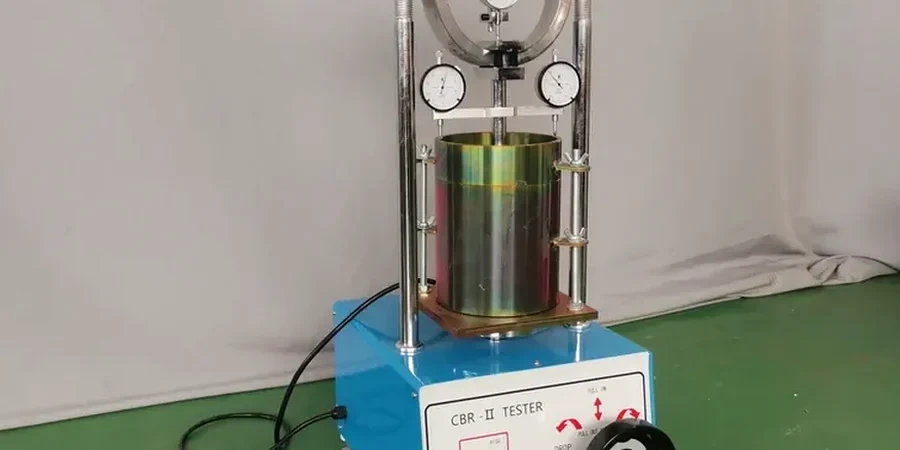
The loading press applies force at a constant 0.05 inches per minute, driving a 1.95-inch piston into the compacted soil specimen inside a 6-inch mold. In Los Angeles, where pavement layers must withstand both heavy traffic loads and ground motion from the San Andreas Fault system, the California Bearing Ratio test is a fundamental index for verifying subgrade strength before asphalt or concrete is placed. The specimen undergoes controlled saturation for 96 hours to simulate worst-case moisture conditions, a process that replicates the effect of winter rain percolating through pavement cracks into the subgrade across the LA Basin. Our laboratory prepares three separate compactive efforts per sample—typically at 10, 30, and 65 blows per lift—to generate the moisture-density curve required by Caltrans Standard Specifications. The relationship between penetration resistance and the standard crushed-stone reference value determines whether native material can support design loads or requires stabilization with cement or lime. This laboratory protocol, executed under ASTM D1883, provides repeatable data that field tests alone cannot deliver, particularly when correlating with CBR for road construction to verify layer coefficients used in the AASHTO 1993 pavement design equation.
A CBR value below 3% at design moisture content means the subgrade cannot support construction traffic without stabilization—a finding that reshapes project budgets before the first grader arrives on site.
Process overview
Los Angeles County maintains over 21,000 lane-miles of paved roadway, from the I-405 Sepulveda Pass to residential streets in the San Fernando Valley, each requiring subgrade characterization before rehabilitation or new construction. The laboratory CBR test quantifies bearing capacity at varying moisture contents—a critical variable in a city where expansive clay soils in areas like Baldwin Hills can lose 40% of their strength when saturated. The procedure measures both unsoaked and soaked CBR values, with the soaked result typically governing design because it reflects the long-term equilibrium moisture condition beneath impervious pavement surfaces. Penetration readings at 0.1-inch and 0.2-inch displacement are converted to CBR percentages, and the lower of the two values is reported unless the 0.2-inch reading is consistently higher across all three compactive efforts. Caltrans Section 26 requires minimum CBR values of 5 to 15 for subgrade, depending on traffic index and pavement type, while base course materials must exceed 80% CBR. The test also records swell percentage during the 96-hour soaking phase—expansive soils exhibiting more than 3% swell require special treatment such as moisture conditioning or removal and replacement. This data feeds directly into the structural number calculation that determines total pavement thickness for the design ESAL loading over a 20-year performance period.
Local geotechnical context
A mixed-use development project in the Miracle Mile district encountered subgrade material that visually appeared competent—a sandy lean clay with moderate density—but produced a soaked CBR of just 2.8% in laboratory testing. The contractor had already mobilized paving equipment based on a preliminary field assessment that suggested 8-10% CBR. The discrepancy occurred because the soil contained montmorillonite clay minerals that expanded dramatically during the 96-hour saturation period, reducing the effective inter-particle friction measured during penetration. The pavement design, originally based on 4 inches of asphalt concrete over 8 inches of aggregate base, required complete revision. The final solution involved 18 inches of lime-treated subgrade extending 2 feet beyond the curb lines, adding $47,000 in change-order costs and delaying the project by 23 working days. This case illustrates why skipping laboratory verification of CBR—relying solely on visual classification or field proxy tests—creates financial exposure that no contingency budget absorbs comfortably. In the Los Angeles regulatory environment, where city inspectors may request certified CBR reports before approving base course placement, the laboratory test serves as both an engineering tool and a compliance document.
Common questions
How long does a laboratory CBR test take to complete in Los Angeles?
The complete cycle requires approximately 7 to 10 business days. Compaction and specimen preparation take one day, the 96-hour soaking phase spans four days, and penetration testing plus data reduction requires an additional two days. Rush turnaround of 5 working days is available for projects on accelerated schedules, such as emergency pavement repairs following winter storm damage.
What CBR value does Caltrans require for roadway subgrade in Los Angeles County?
Caltrans Section 26 specifies minimum R-value requirements rather than direct CBR thresholds, but the correlation commonly used in Los Angeles practice converts an R-value of 20 to approximately 5% CBR for low-volume roads, and R-value of 40 to roughly 10% CBR for high-traffic corridors. For city street projects under LADOT jurisdiction, a minimum soaked CBR of 5% is typically specified, though designs for bus rapid transit lanes may require 10-15% CBR in the upper 12 inches of subgrade.
How much does a laboratory CBR test cost for a project in the Los Angeles area?
A single-point CBR test—one specimen at three compactive efforts with unsoaked and soaked penetration readings—ranges from US$130 to US$210 depending on whether the client provides the field sample or requires our laboratory to prepare it from bulk material. A three-point CBR family of curves suitable for pavement design optimization costs proportionally less per point, typically falling between US$350 and US$550 for the complete data set including the moisture-density relationship and swell measurements.
Can CBR test results from one location be used for an entire Los Angeles street project?
No. The Los Angeles Basin exhibits significant lateral variability in alluvial deposits, with CBR values sometimes changing by a factor of 3 within 200 feet. Caltrans and LADOT both require sampling frequencies appropriate to the project length—typically one test per 500 to 1,000 linear feet for arterial streets, with additional tests at cut-fill transitions and locations where visual soil changes are observed during grading. Extrapolating a single CBR result across a full alignment creates unacceptable risk of under-designed pavement sections that fail prematurely.