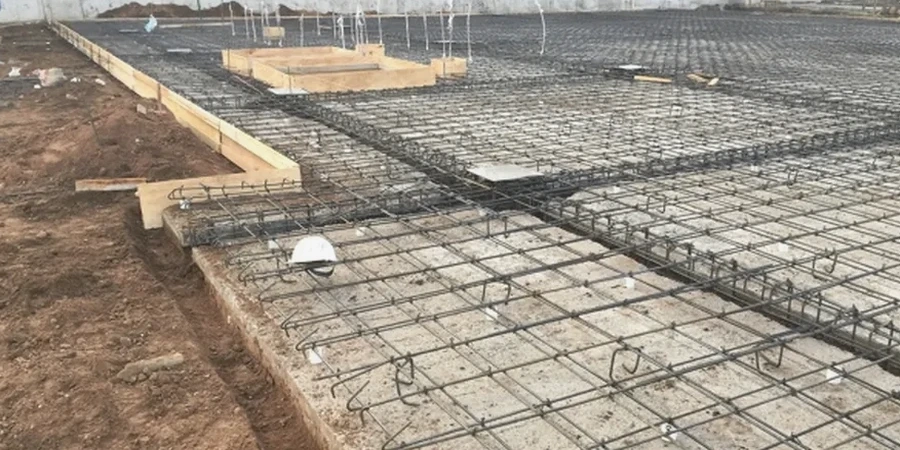
Los Angeles sits atop a deep sedimentary basin that amplifies shaking during an earthquake—we saw this clearly during the 1994 Northridge event, when peak ground accelerations surprised even seasoned engineers. In our experience, raft and mat foundation design in LA isn't just about bearing capacity; it's about controlling differential settlement across irregular alluvial deposits while bracing for the next big one. The basin's geology demands more than a generic slab. When we analyze a site in neighborhoods from Sherman Oaks to South LA, we're looking at liquefiable sands, stiff clays, and sometimes undocumented fill—all within the same city block. A properly configured mat foundation distributes structural loads across this variability, and we combine our geotechnical investigation with a seismic microzonation to refine the design spectrum before running the soil-structure interaction model.
In the LA Basin, a mat foundation isn't just a thick slab—it's the seismic fuse that coordinates how the entire structure rides out basin-amplified ground motion.
Process overview
Much of LA's development sits on Pleistocene-age Lakewood formation silts or younger Holocene alluvium from the Los Angeles River, where groundwater can rise within 20 feet of the surface during wet years. For raft and mat foundation design, we model the complete soil column. We run consolidation tests on Shelby tube samples to capture settlement rates, then overlay that with a response spectrum per ASCE 7-22 Chapter 21. The mat thickness often lands between 24 and 48 inches here—not a rule, but a starting point we refine after analyzing the subgrade modulus derived from plate load tests. Our lab follows ASTM D2487 for classification and ASTM D1586 for SPT correlation, ensuring the design parameters fed into the finite element model match what's actually under the site. We've found that incorporating a perimeter stiffening beam into the mat geometry helps manage edge moments in the softer clays found near the Ballona Creek watershed.
Reference standards
ASCE 7-22 (Minimum Design Loads for Buildings and Other Structures), IBC 2024 (International Building Code, Chapter 18 Soils and Foundations), ASTM D1586 (Standard Penetration Test), ASTM D2487 (Unified Soil Classification System), California Building Code Title 24, Part 2
Common questions
What does raft/mat foundation design typically cost for a single-family home in Los Angeles?
For a standard residential mat foundation design in LA, including the geotechnical investigation, lab testing, and the engineering calculations, the fee usually ranges from US$970 to US$4,400. The final number depends on site access for the drill rig and the complexity of the soil profile.
When is a mat foundation better than isolated footings in LA?
We recommend a mat over individual footings when the site has highly variable soils, when liquefaction potential is moderate, or when the structural loads are heavy and column spacing is tight—common in hillside construction where cut-fill transitions create differential settlement risks.
How do you account for LA's seismic risk in the mat design?
We start with the ASCE 7-22 ground motion maps and adjust for basin effects using site-specific shear wave velocity data. The design spectrum is applied in the structural model to check that the mat thickness and reinforcement can handle the amplified short-period acceleration we expect in the LA Basin.
How long does the design process take from investigation to stamped plans?
After we mobilize the drill rig and recover samples, lab testing runs about two weeks. The analysis and drafting of the mat foundation plans typically take another two to three weeks, assuming no major surprises in the soil profile.