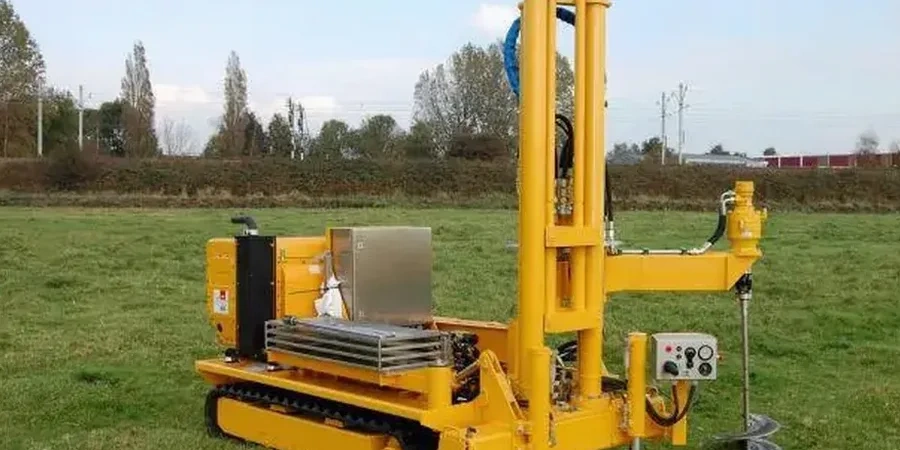
The 20-ton CPT truck positions its hydraulic rams against the chassis, pushing a 15 cm² instrumented cone at a steady 2 cm/sec into the Los Angeles ground. The cone tip houses a load cell measuring penetration resistance while a porous filter element simultaneously records pore water pressure generation in real time. Los Angeles presents a unique vertical puzzle for this equipment: Holocene alluvium from the Los Angeles River transitions abruptly into the stiff Pleistocene San Pedro sands, and the cone must traverse both without disturbing the in-situ fabric. From our experience running CPT soundings across the LA Basin, we see friction ratios shift dramatically at the contact between the soft harbor clays and the underlying fluvial deposits, a boundary that rotary drilling often smears beyond recognition but the cone captures with centimeter-level accuracy. In liquefaction-prone zones near the Newport-Inglewood fault, probe refusal on dense gravel lenses is a common signal we interpret using pore pressure dissipation tests right at that refusal depth.
A single CPT sounding in the LA Basin replaces four boreholes when the goal is a continuous stratigraphic profile with pore pressure data.
Process overview
The post-war expansion of Los Angeles across the alluvial fans of the San Gabriel Mountains fundamentally altered the geotechnical profile of the city. Entire neighborhoods in the San Fernando Valley sit atop engineered fill placed during the 1950s and 1960s, often undercompacted by modern standards and highly susceptible to settlement under seismic excitation. What makes CPT uniquely suited to this urban geology is its ability to detect thin, problematic layers — a 20-centimeter silt seam within a sand deposit, or an organic clay lens at the base of a fill — that standard SPT intervals would miss entirely. In our practice, we integrate the cone data with a
MASW survey to correlate the stratigraphy with shear wave velocity profiles, essential for site classification per ASCE 7-22 Chapter 20. For projects near the Los Angeles River, where channel migration has left behind buried paleochannels filled with loose granular soils, the continuous tip resistance curve reveals these hidden features with a clarity that no other in-situ test provides. We also pair CPT data with
liquefaction analysis using the Boulanger and Idriss (2014) triggering procedures to quantify the factor of safety against flow failure in the event of a major seismic event on the Puente Hills thrust system.
Local geotechnical context
The Los Angeles Basin sits atop a deep sedimentary trough where groundwater in the Gaspur aquifer rises to within 3 meters of the surface across much of the coastal plain. This shallow water table, combined with the fine-grained Holocene clays deposited by the ancestral Los Angeles River, produces a soil profile that is highly susceptible to cone-induced excess pore pressure buildup. When the CPT penetrates these sensitive clays at the standard 2 cm/sec rate, the measured tip resistance can be elevated by 15 to 20 percent above the true drained value, a phenomenon we account for by running dissipation tests at critical horizons. The bigger risk, however, is undetected liquefiable lenses: a 40-centimeter layer of loose silty sand sandwiched between stiff clay units may exhibit a cone tip resistance of only 2 to 3 MPa, well below the threshold for triggering flow liquefaction under the cyclic shear strains imposed by a magnitude 6.7 earthquake on the nearby Whittier fault. Missing such a layer means the foundation design assumes competent bearing material where none exists, a miscalculation that can lead to differential settlements exceeding 10 centimeters post-seismic event.
Common questions
What is the typical cost of a CPT sounding in Los Angeles?
For a standard piezocone sounding to 20 meters depth with continuous data acquisition at 10 mm intervals, the cost ranges from US$160 to US$260 per meter depending on site accessibility, traffic control requirements, and whether seismic cone modules are included. A typical investigation with three soundings and one dissipation test per sounding falls in the US$4,800 to US$7,800 range for the complete field program, with the data report delivered within 48 hours of site completion.
How does CPT compare to SPT for Los Angeles basin soils?
CPT provides a continuous vertical profile with data every 10 millimeters, whereas SPT yields a single data point every 1.5 meters. In the interbedded silts and clays of the LA Basin, the SPT can easily miss thin liquefiable seams that the cone detects. Additionally, CPT avoids the borehole disturbance and stress relief that affect SPT blow counts in soft clays. For seismic site classification, the CPT's direct pore pressure measurement and optional shear wave velocity module make it the preferred tool under ASCE 7-22.
What depth can a CPT truck reach in Los Angeles soils?
In the soft Holocene clays of the Los Angeles coastal plain, we routinely reach 25 to 30 meters with a 20-ton reaction truck. However, in areas near the San Gabriel foothills or along the Newport-Inglewood fault zone, dense Pleistocene gravels and cemented sands can cause refusal at depths as shallow as 8 to 12 meters. We assess the likelihood of refusal during the desk study phase using available geologic maps and nearby borehole logs.
Do you need a separate geophysical survey if you run seismic CPT?
No, the seismic cone module measures shear wave velocity directly at 1-meter intervals during the same push, providing the Vs30 profile required for IBC and ASCE 7-22 site classification. This eliminates the need for a separate MASW or downhole survey, which is particularly advantageous on congested Los Angeles sites where additional equipment mobilization would require extra traffic control and lane closures.