The Los Angeles Basin sits on a complex mix of alluvial deposits, dense marine sediments, and weathered bedrock—all shaped by millennia of river flow and tectonic uplift. With groundwater as shallow as 15 feet in the coastal plain and active faults just a few miles away, every foundation decision starts with what lies beneath the surface. A soil mechanics study gives us the numbers that matter: shear strength, compressibility, permeability, and consolidation behavior. We run these tests because LA’s diverse geology demands site-specific parameters. What works in the stiff Pleistocene gravels of the Westside won’t hold up in the softer Holocene clays near the LA River. Before a structural engineer draws a single line, we need the soil’s full mechanical profile—including its response under seismic loading. For sites near known liquefaction zones, we often complement the investigation with targeted liquefaction analysis to quantify cyclic stress ratios and settlement potential.
In LA’s seismic setting, soil mechanics isn’t just about bearing capacity—it’s about predicting how the ground will behave during strong shaking.
Process overview
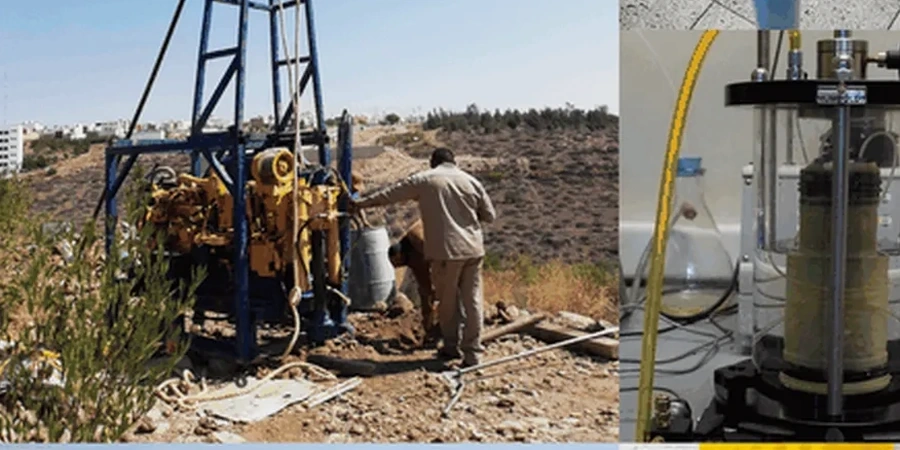
Our field crews typically mobilize a truck-mounted drill rig with automatic SPT hammers and Shelby tube samplers for undisturbed recovery. In tight urban lots east of Downtown LA, we switch to a compact track-mounted unit that can access narrow alleys without compromising depth capacity. The sampling protocol follows ASTM D1586 for standard penetration resistance, paired with thin-walled tube sampling for laboratory consolidation and triaxial work. Back at the lab, we run a full suite: unconfined compression, direct shear on granular samples, and CU triaxial tests with pore pressure measurement. Grain size distribution per ASTM D6913 and Atterberg limits per ASTM D4318 let us classify the soil precisely using the Unified Soil Classification System. The output is a complete stress-strain picture—not just a boring log. When the stratigraphy suggests problematic fine-grained layers, we combine these results with Atterberg limits testing to nail down the plasticity index and predict shrink-swell behavior.
Common questions
How much does a soil mechanics study cost in Los Angeles?
For a typical single-family residential or small commercial project in Los Angeles, a soil mechanics study ranges from US$2,770 to US$5,940. The final cost depends on the number of borings, sampling depth, and the lab testing program. Sites requiring liquefaction assessment or consolidation testing on multiple samples fall toward the higher end.
What’s the difference between a soil report and a soil mechanics study?
A standard soil report often focuses on classification and basic bearing capacity. A soil mechanics study goes deeper—literally and analytically. It quantifies shear strength, compressibility, permeability, and stress-strain behavior under drained and undrained conditions. This is what structural engineers need for complex foundation design in seismic zones.
How deep do you drill for a soil mechanics study in LA?
Depth depends on the foundation type and site conditions. For shallow footings, we typically sample to 30 feet or 2 times the footing width, whichever is greater. Deep foundation projects—piles or drilled shafts—often require borings to 60 or 80 feet. Sites in liquefaction zones may go deeper to characterize the critical layers.
How long does the lab testing phase take?
Consolidation tests run 24 to 48 hours per sample. Triaxial tests with pore pressure measurement take about a week per set. A full soil mechanics study with multiple samples typically delivers the final report in 3 to 4 weeks from the completion of fieldwork.