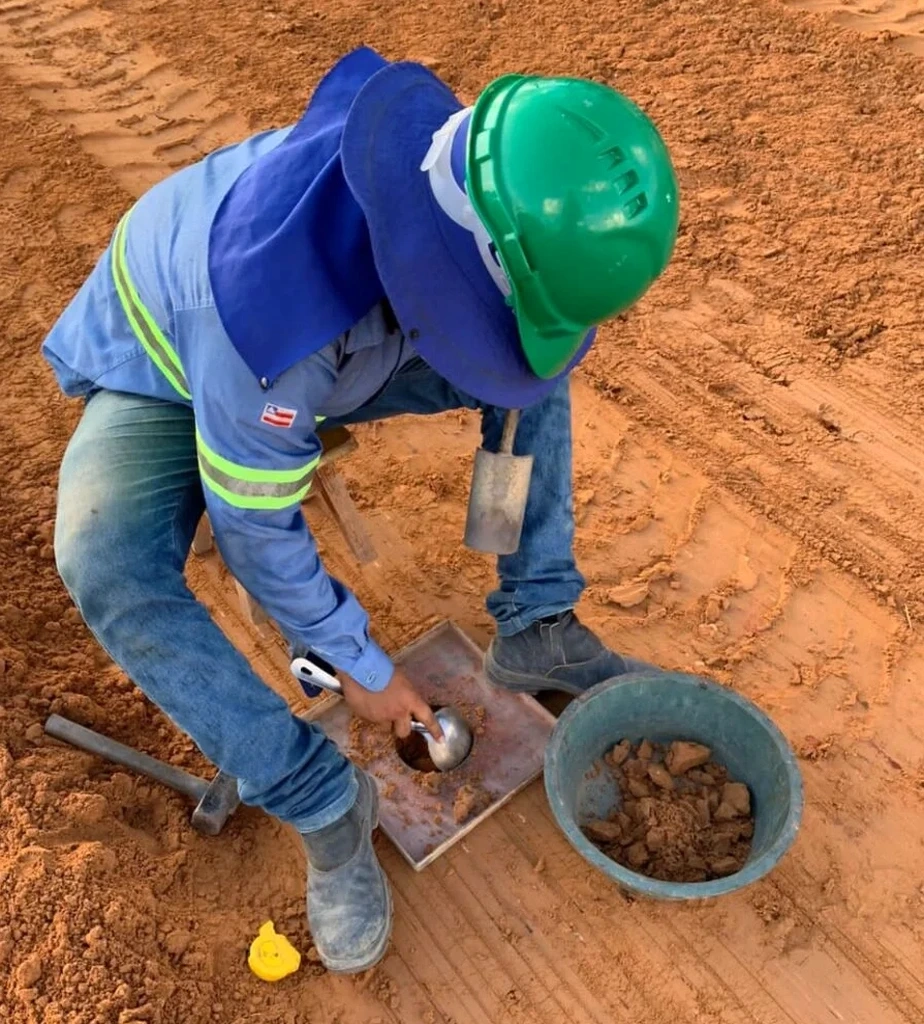
One of the most expensive mistakes a grading contractor can make in Los Angeles is assuming the compactor operator achieved 95% relative compaction just by counting passes. We've seen entire building pads fail inspection because the proof roll looked fine but the sand cone test told a different story—areas of the Santa Monica Mountains with decomposed granite often hit spec on the first try, while the same effort on silty fill near the LA River leaves voids that cause differential settlement within the first rainy season. The sand cone method remains the referee for earthwork acceptance, and skipping it is a gamble no superintendent should take. Before we mobilize, we typically coordinate with the plate load test team if the structural engineer wants bearing capacity data on the same lift, and we often run a quick grain size analysis on the fill material to confirm the lab proctor curve matches what's actually being placed.
A 98% relative compaction number from a sand cone test is meaningless if the reference proctor doesn't represent the fill actually being placed—material verification matters as much as the field technique.
Local geotechnical context
The Los Angeles Basin's Mediterranean climate produces a dry season from May through October where fill soils can lose 3–4% moisture content in a single afternoon, and a wet season where a 2-inch storm can saturate the upper lift and turn a passing compaction zone into a soft spot overnight. This seasonal swing creates a moving target for field density acceptance: material that tested at 96% on a cool morning with marine layer moisture might be 89% by 2:00 PM after the Santa Ana winds have pulled the water out. Our technicians track ambient temperature, relative humidity, and soil temperature at each test location, and we'll recommend a moisture conditioning adjustment before the contractor wastes a shift rolling material that's drifted 3% above optimum. The IBC Chapter 18 and the Los Angeles Municipal Code Section 91.7004 both require density testing on engineered fills, and the geotechnical engineer of record typically reviews every sand cone report before signing off on the next lift placement.
Reference standards
ASTM D1556: Standard Test Method for Density and Unit Weight of Soil in Place by Sand-Cone Method, ASTM D698 / D1557: Standard Proctor and Modified Proctor for laboratory reference density, ASTM D2487: Unified Soil Classification System for field identification of fill materials, IBC Chapter 18: Soils and Foundations, Section 1803.5 compaction requirements, Los Angeles Municipal Code Section 91.7004: Grading and earthwork inspection requirements
Common questions
How much does a sand cone density test cost in Los Angeles?
A single sand cone test in the LA metro area typically runs between US$110 and US$170 per location, depending on travel distance and the number of tests performed on the same mobilization. Most grading contractors schedule a minimum of 6–10 tests per day to keep the per-test cost at the lower end of that range.
How deep does the sand cone test hole need to be?
The test hole must extend through the full thickness of the compacted lift being evaluated, which in Los Angeles earthwork is typically 6 to 12 inches. The hole diameter must be at least three times the maximum particle size in the fill, and the walls should be as vertical as possible to avoid sand volume errors.
Can you use the sand cone method on aggregate base or crushed stone?
The sand cone method works on aggregate base provided the maximum particle size does not exceed about 1.5 inches and the material is not so open-graded that the calibration sand infiltrates the voids. For coarse, open-graded base rock, a water replacement method or nuclear gauge with site-specific correlation is often more reliable.
What does LADBS require for compaction testing frequency?
The Los Angeles Department of Building and Safety generally requires a minimum of one field density test per 1,500 square feet per lift, with additional tests at the discretion of the deputy inspector. Structural fill zones beneath footings, retaining wall backfill, and utility trench backfill often require tighter spacing, and the geotechnical engineer's report will specify the final frequency.