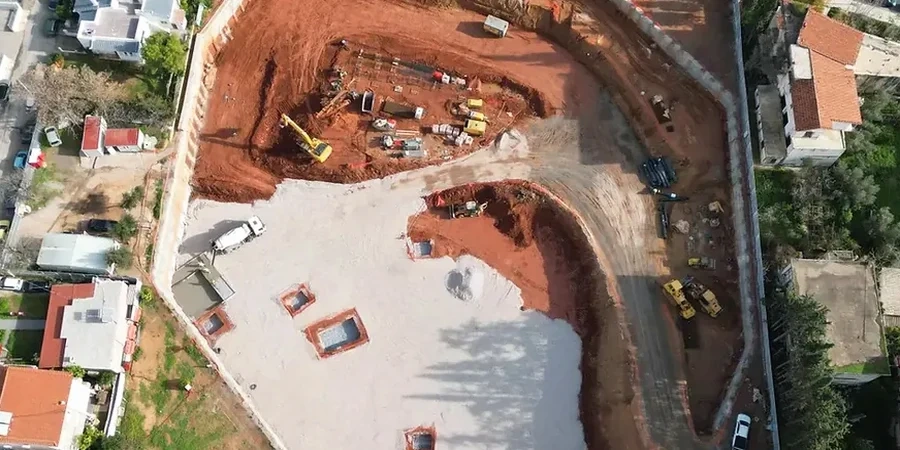
When the excavator arm swings onto a downtown LA lot or a hillside site in the Santa Monica Mountains, the first few buckets of soil usually tell a story of eroded granite, layered alluvium, and sometimes a pocket of gas-charged sand nobody expected. Designing a deep excavation here isn't a copy-paste job from a manual. We start with the rigs that matter: hollow-stem augers for groundwater readings, CPT rigs that push cone penetrometers through soft basin deposits without losing pore pressure data, and seismic gear that captures shear-wave velocities right at the shoring line. The CPT test helps us map continuous stratigraphy where interbedded clays and silts make traditional sampling too slow, giving contractors a real-time profile before the first soldier pile goes in. Our team has worked excavations from the Wilshire corridor to the edge of the LA River, and we know that a design that ignores the city's peculiar mix of young alluvium, deep artificial fill, and the ever-present Newport-Inglewood fault zone is a design that will cost someone a lot of headache later.
Designing a shoring system in LA means accounting for a 7.8 magnitude rupture on the San Andreas while managing groundwater that hasn't seen daylight since the Pleistocene.
Process overview
Los Angeles sits on a crazy-quilt geology where the dry, compacted Pleistocene gravels of the San Fernando Valley behave nothing like the marine silts you hit two miles closer to the coast. Morning fog and seasonal Santa Ana winds don't just mess with concrete curing; they change the moisture profile in exposed excavation faces, and that can trigger raveling in sandy layers that looked stable during the geotech investigation. We address this by integrating laboratory index testing from our ISO/IEC 17025-accredited lab directly into the finite element model, so the retaining system accounts for suction loss during dry spells and saturation spikes after a winter storm. The shoring design typically follows IBC Chapter 18 and ASCE 7-22 load combinations, checking cantilever and tied-back wall performance under both static and seismic earth pressures. Groundwater is the wildcard here. In parts of the LA Basin, the water table sits shallow enough to require base stability analysis with seepage forces, especially where old oil field sumps or unmapped well casings create preferential flow paths. A solid dewatering plan paired with a well-instrumented monitoring program isn't an add-on; it's what separates a clean basement dig from a very public slope failure.
Local geotechnical context
LA's vertical expansion really kicked off in the 1960s when Wilshire Boulevard started sprouting high-rises above the old tar seeps and bean fields. That legacy means many of today's deep excavations sit cheek-by-jowl with aging brick structures, underground parking garages from the 1920s, and utilities that no one ever mapped in CAD. The biggest risk isn't just the soil—it's the adjacent building that hasn't been underpinned properly, or the fiber optic line that runs three feet behind the property line. Add in the city's mandatory methane mitigation requirements in the Methane Zone and High Potential Methane Zone, and you've got a design envelope that demands a lot more than a generic earth pressure diagram. We've seen projects stall because the geotech report didn't address the potential for cyclic softening in sandy layers during a moderate earthquake, something the Seed & Idriss framework has been warning us about for decades. A properly peer-reviewed excavation design, backed by instrument data and a clear trigger-action-response plan, is the only way to manage the liability that comes with digging deep in a seismically restless city.
Common questions
What is the typical cost range for geotechnical design of a deep excavation in Los Angeles?
For a typical commercial basement dig or mid-rise shoring project in the LA area, the design fee runs between US$2,310 and US$8,340 depending on depth, number of retained sides, groundwater complexity, and whether the project falls within a Methane Zone requiring additional detailing. A simple single-tier soldier pile design on a dry site sits at the lower end; a multi-level tied-back wall with dewatering and extensive instrumentation moves toward the upper bound.
How do LA's seismic requirements affect the shoring design?
The design must include seismic earth pressure increments per ASCE 7-22, typically modeled as a pseudo-static load. We also evaluate the potential for liquefaction-induced lateral spreading if the excavation base or retained soil mass contains loose saturated sands. In high seismic hazard zones, the structural connections between walers, tiebacks, and piles are detailed to accommodate the ductility demands expected during a design-level earthquake.
What triggers the need for a Methane Mitigation Design for an excavation?
The Los Angeles Department of Building and Safety (LADBS) designates Methane Zones and High Potential Methane Zones across much of the basin. If your site falls within one, the excavation and shoring design must incorporate gas-resistant membranes, venting systems, and often a passive or active collection layer beneath the slab. This requirement is separate from the structural geotechnical design but must be coordinated so the shoring system doesn't compromise the methane barrier continuity.