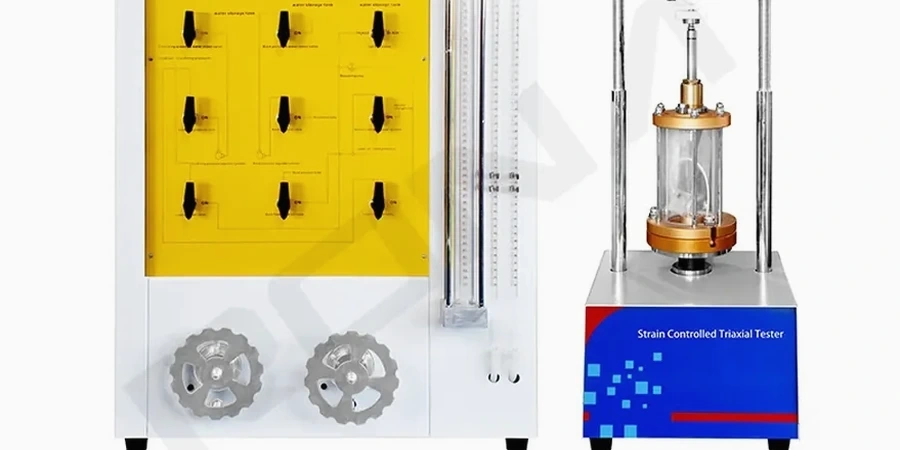
A 20-story tower rising along Wilshire Boulevard faces more than just the challenge of height. The real question sits sixty feet underground, where saturated silts and sands of the LA Basin must carry immense structural loads through a matrix of deep piles. When the geotechnical team for that tower needed to model the stress-strain behavior of these deep strata, they turned to multi-stage triaxial tests that could replicate the exact overburden pressures found at depth. Without that data, the pile design would have been an educated guess, not an engineered solution. The triaxial test provides the shear strength parameters that structural engineers require to move from concept to construction, and in a seismically active city like Los Angeles, where the ground can shake with accelerations exceeding 0.5g near the Newport-Inglewood fault, the precision of those parameters is non-negotiable. Complementing the in-situ permeability measurements taken in the field, the laboratory-derived friction angle and cohesion values define the very foundation of the project.
Effective stress parameters from a triaxial test are the difference between a safe deep excavation and a failure that starts without warning.
Process overview
The geology beneath Los Angeles is famously complex, a patchwork of Pleistocene alluvium, marine sediments, and weathered bedrock that changes within a few blocks. Down near the LA River, you might encounter soft clays with undrained shear strengths below 500 psf, while up in the Hollywood Hills, compacted sandy silts may withstand far greater loads. A consolidated-undrained triaxial test with pore pressure measurement, conducted according to ASTM D4767, allows us to separate effective stress parameters from total stress behavior, which becomes critical when designing a
deep excavation shoring system where groundwater drawdown alters the stress regime. In Los Angeles, where the groundwater table can rise significantly during El Niño winters, understanding how saturation affects shear strength is not an academic exercise; it is a practical necessity. The
CPT test provides a continuous profile of tip resistance and sleeve friction, but the triaxial test gives us the fundamental strength envelope that validates the CPT correlations for the specific soil formations encountered beneath the city.
Local geotechnical context
What we see repeatedly across Los Angeles job sites is a misplaced confidence in SPT blow counts alone. An N-value of 15 in a silty sand near Santa Monica may correlate to a friction angle of 30 degrees in a textbook, but that correlation was developed for clean sands in a different geologic setting. When a shoring contractor uses that assumed angle to design a soldier pile wall, and the actual soil exhibits a friction angle of 26 degrees under triaxial conditions, the wall can deflect beyond acceptable limits. The risk is compounded in areas like the Palos Verdes Peninsula, where ancient landslide debris introduces variability that no correlation can capture. A slope stability analysis that relies on triaxial-derived effective stress parameters, rather than generalized correlations, will reveal failure surfaces that simplified methods miss entirely. The cost of the test is insignificant compared to the cost of a slope failure or a foundation that settles beyond tolerance.
Common questions
What is the typical cost range for a triaxial test program in Los Angeles?
For a standard program involving three multi-stage consolidated-undrained triaxial tests on undisturbed samples from the LA Basin, the cost typically falls between US$1,620 and US$2,560. The exact figure depends on the sampling depth, the number of confining stages per specimen, and whether pore pressure measurement or back-pressure saturation is required.
How long does a triaxial test take from sample recovery to final report?
A consolidated-undrained test with pore pressure measurement generally requires five to seven calendar days for saturation, consolidation, and shear phases. If the soil is a low-permeability clay from a deep Los Angeles formation, the consolidation phase alone may extend to three days. We typically deliver the interpreted strength parameters within eight business days of sample receipt.
Which type of triaxial test is most appropriate for a deep excavation in Downtown LA?
For a deep excavation where groundwater drawdown will occur during construction, we recommend a consolidated-undrained test with pore pressure measurement (ASTM D4767). This provides both total and effective stress parameters, allowing the designer to analyze short-term stability during excavation and long-term stability after pore pressures have equilibrated.
Can triaxial testing be performed on remolded or reconstituted specimens?
Yes, and this is particularly useful in Los Angeles when evaluating fill materials or when undisturbed sampling is not feasible. We reconstitute specimens to a target density and moisture content representative of field conditions. While remolded tests do not capture soil structure effects, they provide a conservative lower-bound strength envelope suitable for preliminary design and for comparison with undisturbed results.