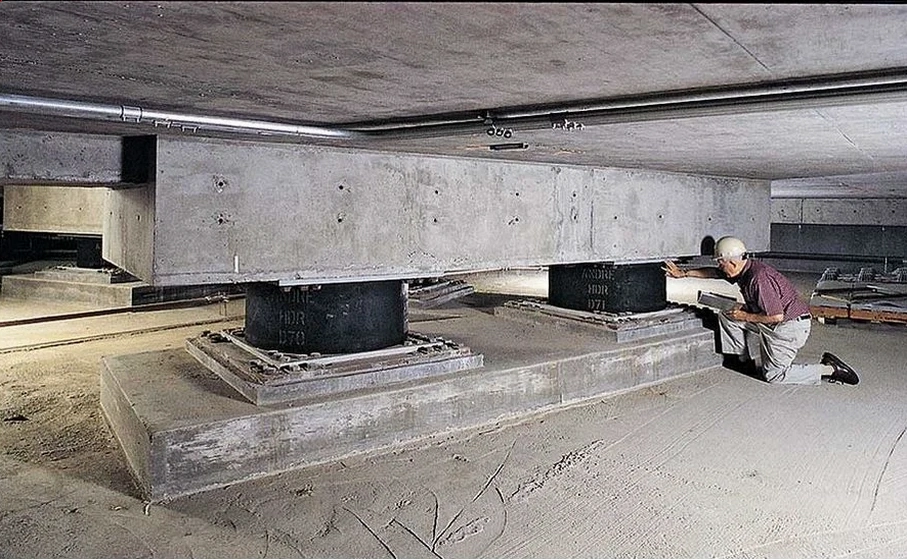
When you work in Los Angeles, you know the ASCE 7 standard isn't a bureaucratic formality—it's the technical backbone. The city sits atop the Newport-Inglewood Fault and is just 45 miles from the San Andreas, with soft basin soils that amplify ground motion. Base isolation seismic design here is an engineering necessity. The 1994 Northridge M6.7 event reshaped how we conceive decoupling strategies. For structures from Santa Monica to Downtown, a liquefaction potential analysis is often the first step before defining the isolator system, because saturated alluvial deposits can fail before the superstructure even feels the lateral load.
In Los Angeles, a poorly calibrated isolator can amplify near-fault pulse effects instead of mitigating them—the bearing's characteristic strength must match the site's seismicity.
Common questions
What is the budget range for a base isolation seismic design package on a mid-rise building in Los Angeles?
For a typical 6- to 12-story structure in Los Angeles, our design package ranges from US$4,390 to US$7,870. This covers the nonlinear time-history analyses, the isolator specification report, and the peer review coordination. The final figure depends on the number of ground motion pairs required and the complexity of the moat detailing.
How does ASCE 7-22 change the isolator testing requirements compared to previous editions?
ASCE 7-22 now requires explicit verification of the isolator's lateral force-displacement loop under three-dimensional loading, including axial force variation due to overturning. It also mandates that the prototype tests include at least one full-scale bearing with the same compounding and geometry used in production. The design review must demonstrate that the isolator's characteristic strength degradation after 10 cycles of MCEr displacement does not exceed 20% of the initial value.
What is the typical moat width for a base-isolated building in downtown Los Angeles?
The moat width is a function of the MCEr displacement and the torsion amplification factor. In downtown LA, for a site class D with a 2-second spectral acceleration above 0.8g, the total displacement demand often falls between 20 and 30 inches. We apply a 30% margin per IBC, plus an allowance for the permanent offset caused by the near-fault velocity pulse. The resulting moat width typically ranges from 28 to 42 inches, measured from the isolation interface to the retaining wall face.
Can an existing building in Los Angeles be retrofitted with base isolation?
Yes, although it requires a detailed constructability analysis. The main challenge is transferring the vertical load from the existing columns to the new isolators, which often involves cutting the ground-floor columns and installing temporary jacking towers. In Los Angeles, we must also verify that the new moat doesn't compromise the existing foundation's passive earth pressure resistance. We've completed retrofit designs under ASCE 41-17 where the isolation layer is installed at the basement level, using friction pendulum bearings that tolerate construction tolerances better than elastomeric types.